

Galaxy Note 10 uses F2FS, not EXT4 file system: What's the difference?
Last updated: Baronial 12th, 2019 at fifteen:38 UTC+01:00
This yr, a couple of Samsung smartphones will make use of a file system other than EXT4, which has been traditionally used on the Android platform nearly exclusively throughout its beingness. The Milky way Annotation ten series, however, switches gears and adopts the F2FS file system together with UFS iii.0 storage. Today we'll explicate some of the benefits to this, and what Samsung fans can expect in the future.
F2FS quick overview
First things get-go, what is a file arrangement? In short, a file system determines how data is stored and retrieved to and from the local storage. Android OS has historically made apply of the EXT4 file system, although some phones over the years – similar the OnePlus 3T – have experimented with the newer F2FS file system instead, even though the same company went dorsum to the EXT4 organisation with its side by side flagship generations.
Interestingly enough, F2FS was introduced in 2012 and was initially developed by Samsung Electronics equally a log-structured file arrangement capable of accounting for the characteristics of storage devices based on NAND wink memory. In dissimilarity, the first stable version of the EXT4 file arrangement was released in 2008 every bit a direct successor to EXT3.
F2FS vs. EXT4 in a nutshell: Speed vs. stability
EXT4 is considered more stable than F2FS every bit it's been effectually for a longer time and doesn't become besides many updates to the underlying structure. F2FS, on the other manus, can become big updates that bring forth major under-the-hood-changes. This makes it a tougher choice for a platform similar Android OS where hardware configurations can vary tremendously and fragmentation is a major effect.
Nonetheless, F2FS tin can also be considerably faster in part considering it'due south a log-structured file organization created primarily for NAND flash memory, and it might go more pop among higher-profile OEMs. Enough years may have gone by for F2FS to get more stable, peculiarly when paired with UFS three.0, and it now seems like Samsung is entertaining the idea of transitioning to F2FS.
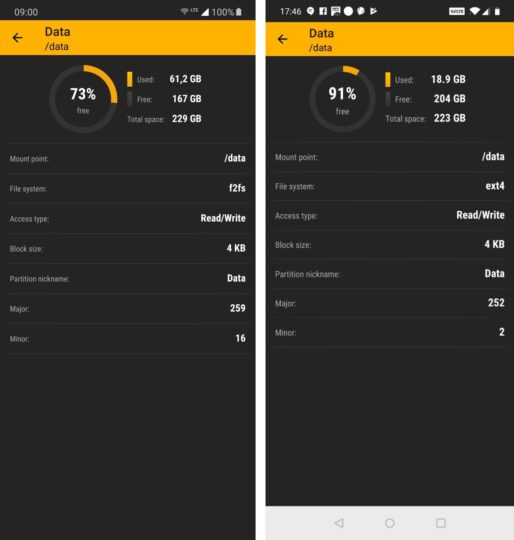
Using this file organization could be the main differentiating factor betwixt devices using UFS 3.0 storage. As seen in the screenshot below, the OnePlus 7 Pro has the same storage standard as the Galaxy Note 10 but uses the EXT4 file system instead of F2FS. An early criterion shows the Galaxy Note 10 outperforming the OnePlus 7 Pro particularly in terms of random and SQLite write speeds, so it would seem similar the newer file system might be going a long way.
What's next? Tin we look F2FS on more than Samsung devices?
Like the Milky way Annotation x, the Galaxy Fold likewise has UFS 3.0 storage, merely because we no longer take our review unit, we are unable to confirm whether it has the same file system (or operation) every bit Samsung'south latest phablet serial. Having said that, the question is whether we should expect F2FS to become more prevalent in Samsung's device lineup in the futurity.
There'due south no fashion to be certain, but if F2FS volition bring plenty benefits to the Galaxy Note x (and maybe the Galaxy Fold), and then the same file system will likely be adopted by future flagships such as the Galaxy S11 series and eventually become a office of devices across all segments, although that could take a few years.
As for older, existing flagships, chances are slim. In theory, the file system could be replaced through a firmware update for older devices that use the EXT4 file system, such as the Galaxy Note 9 or Milky way S10. However, the procedure would require users to exercise a complete wipe of their phones' memory and this is probably non going to be an selection Samsung will give to the masses.

Source: https://www.sammobile.com/news/galaxy-note-10-uses-f2fs-not-ext4-file-system-whats-the-difference/
Posted by: riddersonch1955.blogspot.com
0 Response to "Galaxy Note 10 uses F2FS, not EXT4 file system: What's the difference?"
Post a Comment